
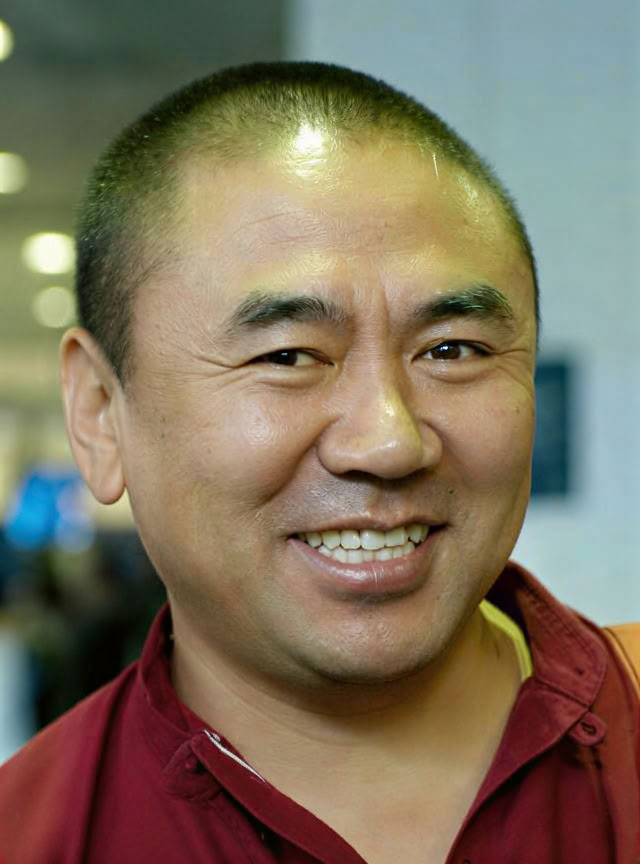
In Tibetan Buddhism, the title Khenpo carries deep significance. It may refer to a scholar who has completed an extensive education in sutra and tantra, a senior lama with the authority to give ordinations, or the head of a monastery. Within the Tibetan monastic tradition, Khenpos have played a vital role in preserving the purity of Buddha’s teachings from one generation to the next, much like a university tradition. The title is exceptionally rare: although many monks devote years to study, only a very small number are recognised as Khenpos. It is conferred in acknowledgment of profound knowledge and exceptional skill in guiding and teaching others. For this reason, His Holiness the Sakya Trizin recognised Khenpo’s deep understanding of Buddhist philosophy and his mastery of both sutra and tantra.
Khenpo was born in 1962 into a Tibetan refugee family. His parents fled Tibet in 1959 after the communist takeover, enduring severe hardship before finding safety. The family lost everything except their lives and began again in Nepal, later travelling through India and taking whatever work they could find to survive. Khenpo’s grandparents, parents, and several older siblings worked in road-building gangs in the Indian Himalayas. For years, the family lived in a tent by the roadside in extreme heat and cold, with little access to education. By 1966, Khenpo’s mother and the younger children had settled in Bir in the lower Himalayas, then a very remote region. When Khenpo was five, he began attending the local school there. At nine, he and his parents agreed that he should become a monk, a great honour in Tibetan culture. He then undertook ten years of intensive training in ritual practice, including memorising hundreds of pages of text, preparing sand mandalas, playing temple instruments, and leading chants.
In 1980, Khenpo left the monastery to study at Sakya College in Dehradun. Admission was highly competitive, and only a few monks were selected. The principal at the time was the Most Venerable Khenchen Appey Rinpoche, a great Sakya scholar and one of the most distinguished Tibetan Buddhist scholars of his generation. Khenpo was fortunate to study under such an accomplished teacher and quickly demonstrated strong ability in Buddhist philosophy. While still working toward his bachelor’s degree, he was appointed a junior teacher at the college. By years 9–10, he had earned his master’s degree in Buddhist studies and was later selected as a lecturer by His Holiness the Sakya Trizin and Khenchen Appey Rinpoche. Many of his students were tulkus, and several later became Khenpos themselves. During these years, he passed numerous written and oral examinations, including traditional public debates observed by His Holiness the Dalai Lama and His Holiness the Sakya Trizin. He completed his final master’s and teaching degree in 1991, then spent a year travelling in India and Nepal and undertaking retreats.
On 8 March 2002, Loppon Ngawang Dhamchoe was formally given the title of Khenpo in a ceremony at Bir Monastery in Northern India, presided over by His Eminence Ratna Vajra Rinpoche and attended by senior lamas and dignitaries. Although he had completed his Loppon degree, equivalent to a PhD, in 1990 and had been invited several times to accept the title, he had previously declined. The enthronement was eventually requested through a letter of authority from His Holiness the Sakya Trizin, conveyed via His Eminence Ratna Vajra Rinpoche and Dagmo Kushola, during the auspicious occasion of the enthronement of the 15th Gyalsay Rinpoche, along with a Long Life ceremony and Mahakala Puja. The title of Khenpo acknowledges outstanding scholarship and teaching ability, and reflects the privilege of learning from a teacher capable of transmitting pure Sakya wisdom to students in Australia and abroad.
In 1992, Gyalsay Tulku Rinpoche asked Khenpo to teach in Singapore, Taiwan, and Malaysia. After Gyalsay Tulku passed away in Canberra at the end of 1993, the Buddhist Centre he had founded in Sydney faced serious difficulties, and students requested a new teacher from His Holiness the Sakya Trizin. Khenpo was then appointed resident teacher at Sakya Tharpa Ling in Sydney. Although he felt unprepared, he accepted because his guru had asked him to go. He arrived in Australia in late 1994 and encountered many challenges: students had drifted away, support was limited, and there were years of concern about paying the rent. Yet his faith, the blessing of his guru, and dreams of Gyalsay Tulku sustained him. Over time, he gained experience and fluent English, membership grew again, and the Centre moved several times before purchasing its own home in Rozelle, the first permanent Sakya centre in Australia. Later, a larger building was acquired in Strathfield, becoming one of the finest Sakya centres in the world. Gyalsay Tulku had founded Sakya Tharpa Ling and led it for five years; Khenpo guided it for 12 years before requesting permission to step aside. In 2006, while on pilgrimage in India, he was asked once more by His Holiness to become spiritual head of Drogmi Retreat Centre in East Kurrajong, west of Sydney. Drogmi Buddhist Institute was later founded by Khenpo Ngawang Dhamchoe and formally incorporated in October 2009 to promote the study, understanding, and practice of Tibetan Buddhism in Australia, as well as the future development of a retreat centre.