

Receive 3 free audio somatic blessings.
In its original form, Hatha Yoga is far more than a physical practice. It is a complete science of the human being, using asana, pranayama, mudra, mantra, kriya, and relaxation to align the individual with the infinite.
Yoga Nidra, too, began as something deeper than a method. Long before it was taught as a technique, it was described as a sacred state of resting awareness — whole, luminous, and complete. In this training, both are explored: the state itself and the practical path that leads back to it.
Classical Tantra carries the same recognition at its heart: consciousness is not something to be built. It is what you already are.
Over 21 days at The Yoga Barn in Ubud, a place known for its powerful energy and living yoga community, you will immerse yourself in three pillars: Hatha, Nidra, and Classical Tantra.
Hatha is not simply about posture. It is the practice of sacred union within yourself.
This training is grounded in classical lineages, including the Hatha Yoga Pradipika, the Gheranda Samhita, and the Kashmir Shaivite non-dual view.
Yoga Nidra is approached in two ways: as an original state of being, and as a refined method that allows practitioners to rest deeply, eyes closed, breath softening, and the whole system settling into what has always been there.
200 Hours. Fully registered with Yoga Alliance. On completion, you are eligible to register internationally as an RYT-200.
Ha is solar. Tha is lunar. The practice is the meeting of the two.
One body. One breath. Two currents brought into harmony.
Hatha is a complete technology of awakening, not improvement. It works across structure, breath, energy, and mind. The six classical practices taught here come from texts that have remained alive for centuries.
Each practice is learned as a teaching tool, because a complete teacher needs a complete map.
Every session has a beginning and an ending. How a class opens matters, and how it closes matters just as much. This training studies both: the art of arrival and the art of departure. Relaxation is never an afterthought; it is where the practice lands.
Asana. The Posture Science. Classical and functional asana across standing, seated, supine, prone, inversion, backbend, twist, and forward fold categories. Topics include alignment, safe sequencing, modifications, hands-on assists, and how to begin and end a practice with intention.
Pranayama. The Breath as Vehicle. A full classical pranayama curriculum including Nadi Shodhana, Kapalabhati, Bhramari, Ujjayi, Sitali, Sitkari, Bhastrika, Sama Vritti, and the science of breath retention. You will learn how to introduce these practices safely and how to work with breath at the start and end of a session.
Mudra. The Language of the Hands. Hasta mudras, Kaya mudras, Mana mudras, and Bandha mudras. Learn how these classical gestures seal and redirect prana, and how to integrate them into asana, pranayama, and meditation.
Mantra. Sound as Structure. Vibration, resonance, the nervous system, bija mantras, Sanskrit pronunciation, and how to open and close a class with sound. Japa is also explored as a meditation anchor.
Kriya. The Purification Practices. Classical Shatkarmas including Trataka, Neti, Kapalabhati as kriya, and Agnisar, introduced with care and context.
Relaxation. Opening and Closing the Space. Systematic relaxation for the beginning and end of every session, including body scan, progressive muscular relaxation, 61-points, breath awareness, and sensing techniques.
Before it was a technique, it was a state of being.
The oldest teachings describe it as the Goddess Nidra, Vishnu’s resting awareness between the dissolution and re-creation of worlds. A state so complete that nothing is missing from it.
The method points you back there.
At the threshold between waking and sleep, the thinking mind softens, the body becomes still, the breath slows, and awareness remains open and present. In this training, Yoga Nidra is studied as both personal practice and a teaching instrument.
The State and the Method. Learn the difference between experiencing Yoga Nidra and guiding it. Understand how Hatha prepares the body, how pranayama prepares the breath, and how Nidra receives what has been opened.
The Classical Stages. Physical relaxation, rotation of consciousness, breath awareness, pairs of opposites, visualization, sankalpa, and return. Each stage is studied in detail so you can eventually teach from direct feel.
The Sankalpa. The heartfelt resolve placed at the threshold. Learn how to help students find one that is true and grounded.
The Voice. Pace, tone, pause, and silence. Learn how to guide from within the state while reading the room with care.
Nidra Across Contexts. Yoga Nidra for general classes, therapeutic settings, trauma, sleep, fertility cycles, and integration after intense practice. You will also write and record your own scripts.
Tantra is not added onto practice. It is remembered beneath it.
Its core recognition is simple and radical: consciousness is not something to develop. It is what you already are. The body is not an obstacle to transcend. It is the field through which Shakti moves.
In this training, Classical Tantra is explored as a living orientation — a way of seeing that returns the practice, the teacher, and the room to their original nature.
The View. Non-dual recognition as the foundation: one consciousness moving through all form.
Shiva and Shakti. Pure awareness and pure energy, the still and the moving, the witness and the pulse.
Spanda. The Sacred Pulse. The subtle vibration at the heart of aliveness, beyond technique and into living experience.
Tantra in the Teaching Room. Holding space without hierarchy, meeting what arises without forcing change, and approaching the student’s body with intelligence and reverence.
The Texts. A living encounter with the Vijñāna Bhairava Tantra, the Shiva Sutras, the Spanda Kartika, and selected verses from the Tantraloka.
The arc of three weeks builds by release, not accumulation.
Early bird pricing is available.
Full Payment:
Emily
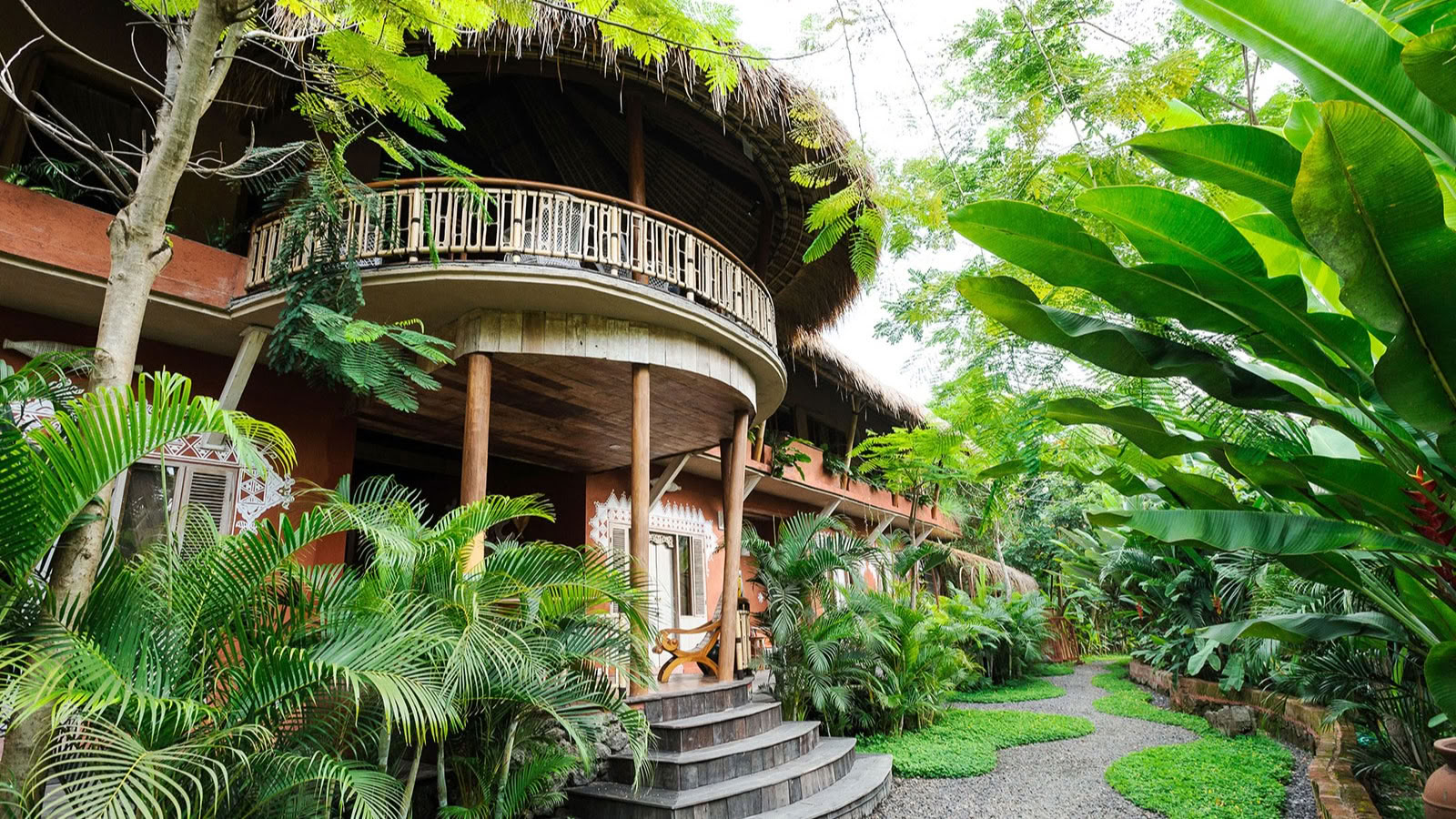
F7M8+PVG, Jl. Sukma Kesuma, Peliatan, Kecamatan Ubud, Kabupaten Gianyar, Bali 80571, Indonesia
Kabupaten Gianyar
Price
$2,995.00
Sat, Sep 26 – Fri, Oct 16