
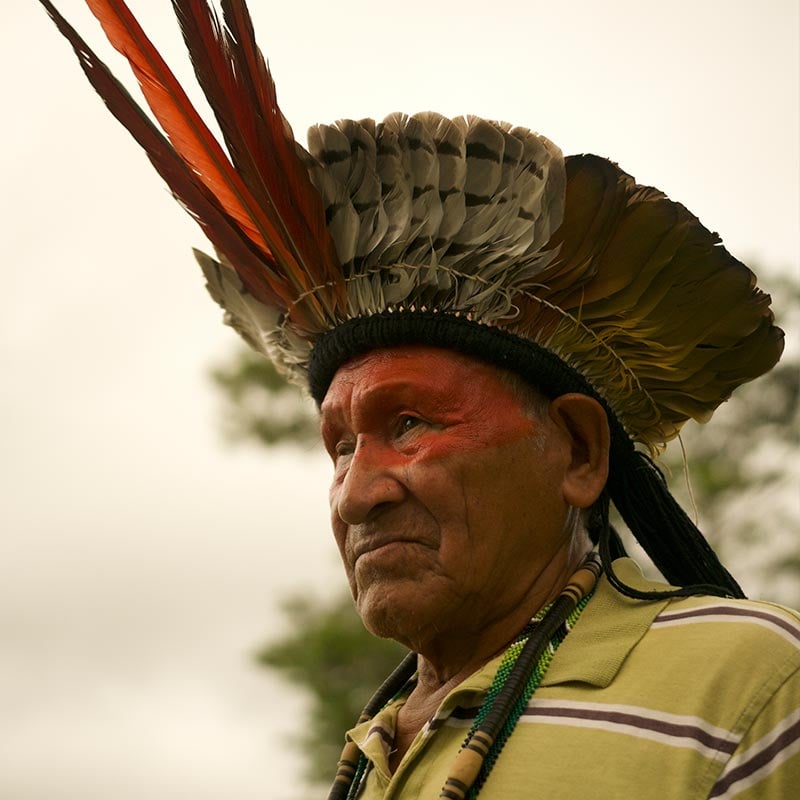
Grandfather. Guide of the ancient time. Humbleness, gentleness, and simplicity.
Medicine man. Guardian of sacred ceremony space.
My name is Vovô Tema João (Tiima Shãwahu). I was born in 1933, I am the oldest pajé (shaman) of the Yawanawá people and the brother of the great pajé Yawaraní who passed away in 2022.
I take nowadays the legacy of an ancient time that has experienced so many changes. I was there when this world looked totally different and I am here now, accompanying with my experience a cultural journey of healing through the world.
I completed the muká diet, the highest spiritual initiation of the Yawanawá tradition, in which a seeker spends one year without drinking pure water while avoiding sugar, sweet fruits, red meat, and sex.
During my study I have been focusing specifically on the medical plants and herbs of the Amazon forest, becoming a master in the field of plant healing and keeper of this knowledge. I am responsible for planting and sustaining the medicinal garden in the newly established spiritual center of Pekã Rasu. The garden is created with the intention of preserving knowledge of the healing herbs and medicine plants of the Amazon alongside the spiritual and healing properties they hold.
I live in Amparo, a beautiful village close to Yawaraní. As an elder, I have a profound understanding of the traditional stories, ancient songs, shamanic culture, and language of my people. I promote ancestral knowledge and stories among the younger to connect them with the language becoming the voice of the ancestors.
I am co-creating with other elders like Pekã Rasu Yawanawá and Pai Nani (Kateyuve) my dream, my own spiritual space of dietas, studies of medicine, and traditions.
“Yawanawá” means “the people of the wild boar”. They are an indigenous community of around 1,500 people who live in nine villages along the Gregório River in the state of Acre, deep in the Brazilian Amazon. Unlike other Amazonian groups scattered across different locations, Yawanawá people are unique because they all live in the same territory and speak the same language. They call themselves “wild boar people” because, as a people, they are always together. They are a pack when they hunt and in life in general.
Their living is still based mainly on hunting and fishing. In the dry season, fishing trips are organised in which almost the whole community participates and transform into important social events –“food festivals”, as the Yawanawá describe them. They use various plant poisons, which, once put in the water, cause the fish to rise to the surface, making their capture easier. During the rainy season, when large animals leave clear tracks, hunting becomes one of the primary alimentation sources.
According to the Brazilian Socio-Environmental Institute, the essential foods obtained from the swiddens are yuca, corn and banana. Other produce is also cultivated through agroforest culture activities, such as rice, sweet potato, papaya, pineapple and sugarcane.
Their social organisation is based on matrilocal residency (matrilocality), a strong family structure that holds together the villages’ economies and socially supports all its members. Their traditional buildings are circular and made of wood and straw. They have no separation, and the fire is placed in the middle.
In the 16th century, the Yawanawá’s first contact with Western Society took place under the leadership of their ancestor Antonio Luís Pekuti. It was a period marked by atrocities against their people, including enslavement by rubber barons.
They only had regular contact with other Brazilians two generations ago when rubber farmers ventured north searching for land and free labour. They survived for centuries by working in plantations. When the price of rubber tanked in the mid-20th century, they started to commercialise annatto, a spiky fruit with seeds that produce red dye used in lipstick, eyeshadows and bronzers.
In the 1980s, cacique (chief) Biraci Nixiwaka Brazil led his people in the fight to recognise their native territories, and the Yawanawá became the first indigenous people to obtain the official rights to their lands in the state of Acre.
In 2006, the Yawanawá became the first tribe to consecrate a female shaman, Hushahu Yawanawá. Their leader, Raimundo Luiz (Tuíkuru), authorised it, supported by the legendary eldest pajé Tatá Yawanawá.
Although today, the most known aspect of Yawanawá shamanism is healing, in the past, the pajé’s (shaman) functions were more varied and touched upon other aspects of culture, such as warfare and hunting. The traditional healing rituals are the “uni”, their most sacred drink, most commonly known as Ayahuasca and “rumê” (Rapé), a traditional way to use tobacco mixed with ashes from the bark of the Tsunu tree.
Other relevant Yawanawá medicines are kapum (kambó), shared in traditional rituals and ceremonies of spiritual purification, regeneration, body cleansing, and healing; Sananga, made from the bark of the root of Tabernaemontana genus and used to open the third eye and inner vision and illuminate subconscious mind patterns; and Sepá, an incense made with the sap of a tree used to protect and clear the space from negative energies, usually in ceremonies.
One of the most arresting features of Yawanawá art is the diversity of body paint designs, or kênes, extensively used in the Mariri festival. The most commonly used dyes are urucum (annatto), a red pigment made from the seeds of the Bixa orellana plant, and genipapo, which produces a dark blue or black pigment. Both are derived from protecting seeds and are sometimes combined with a fragrant resin to help fix the dyes to the skin.
Yawanawás are specialists in the technique of arts and crafts, chanting, and the art of playing music, translating traditional stories into a modern interpretation. Their songs tell stories of connection to the land, reverence for the spirits, and the resilience of Indigenous communities in the face of contemporary challenges. Their music is usually composed of voice, guitars and drums.