
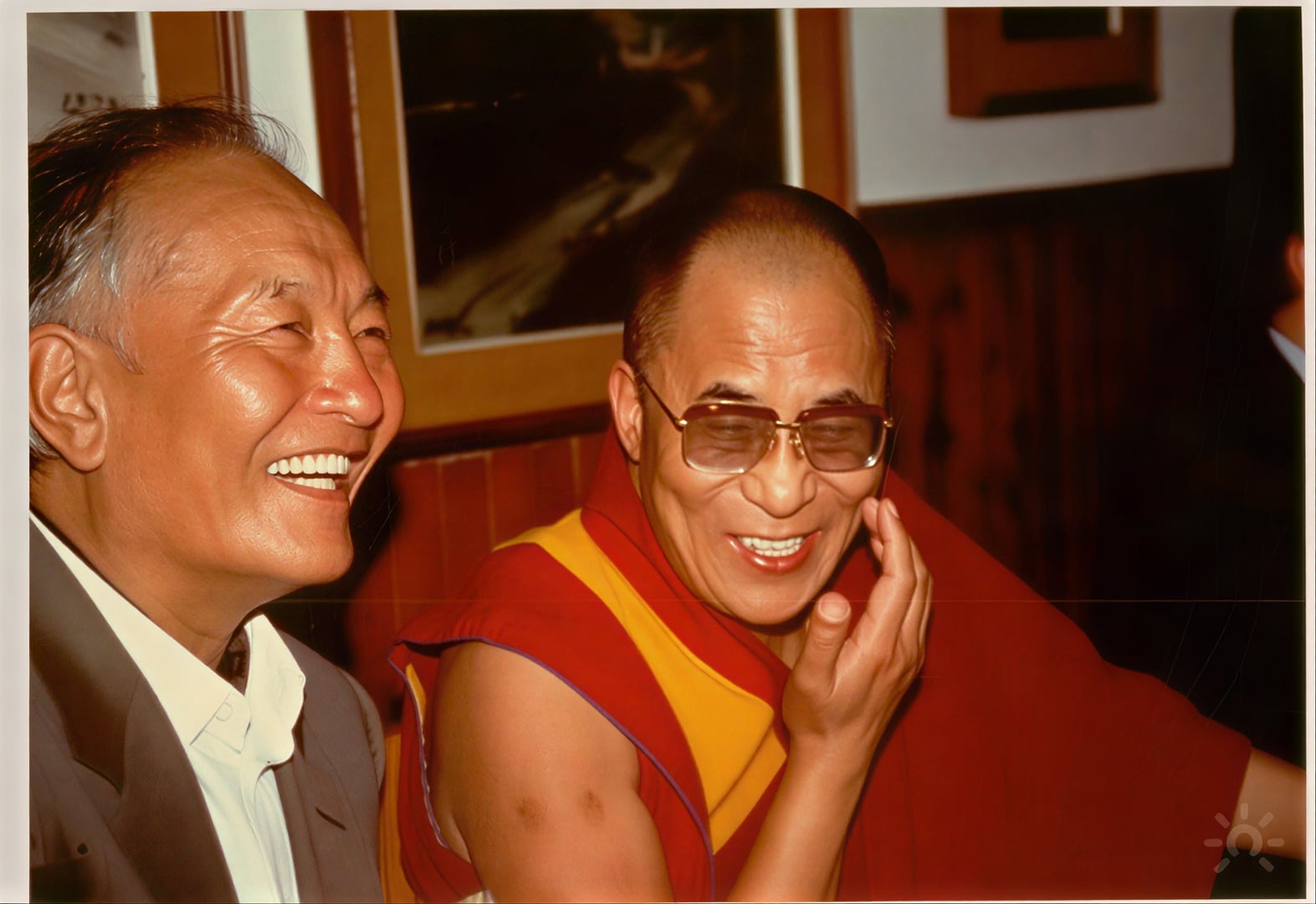

Born on 8 December 1938 in Dege, Eastern Tibet, Chogyal Namkhai Norbu Rinpoche was a renowned teacher and master of Dzogchen, one of the teachings of Buddha. From an early age, he was recognized as the reincarnation of Adzam Drugpa, another great Dzogchen teacher. He was later identified as the mental manifestation, or Mind Emanation, of Drug Shabdrung Rinpoche, another well-known master.
His principal teachers included Changchub Dorje, Ayu Khandro, and his uncles Togden Orgyen Tendzin and Jamyang Chokyi Wangchuk. After completing his training in both Sutra and Tantra, he left Tibet and spent many years teaching Tibetology at the University of Napoli in Italy. In 1976, he began teaching Dzogchen in Italy and later founded the International Dzogchen Community. This community established many centers, known as Gars, around the world, with major centers in Italy, Venezuela, the United States, Argentina, Australia, and Russia.
Chogyal Namkhai Norbu Rinpoche was also known for using modern technology to share his teachings. His sessions were often transmitted online through audio and video webcasts. With the support of synchronization technology, he offered Dzogchen transmission worldwide three times a year for students who were unable to attend a retreat in person. He also wrote many books on Dzogchen and continued teaching actively throughout his life.
In some schools of Tibetan Buddhism and Bon, Dzogchen is understood as the natural, primordial state of every sentient being, including every human being. This ultimate nature is described as pure, self-existing, all-encompassing awareness. It has no form of its own, yet it can perceive, experience, reflect, and express all forms without being permanently changed by them. Dzogchen masters often compare it to a mirror that reflects everything with complete openness, or to a crystal ball that takes on the color of whatever it rests upon without itself being altered. Other expressions used to describe it include “effulgence,” “all-pervading fullness,” and “space that is aware.” When a person can remain in the rdzogs chen state continuously, they no longer experience dukkha, or the feelings of dissatisfaction, tension, and anxiety in everyday life.